
National Commission to Investigate Violations of Human Rights Launches Its Fourteenth Periodic Report on Human Rights Violations in Yemen
Aden | 17 September 2026
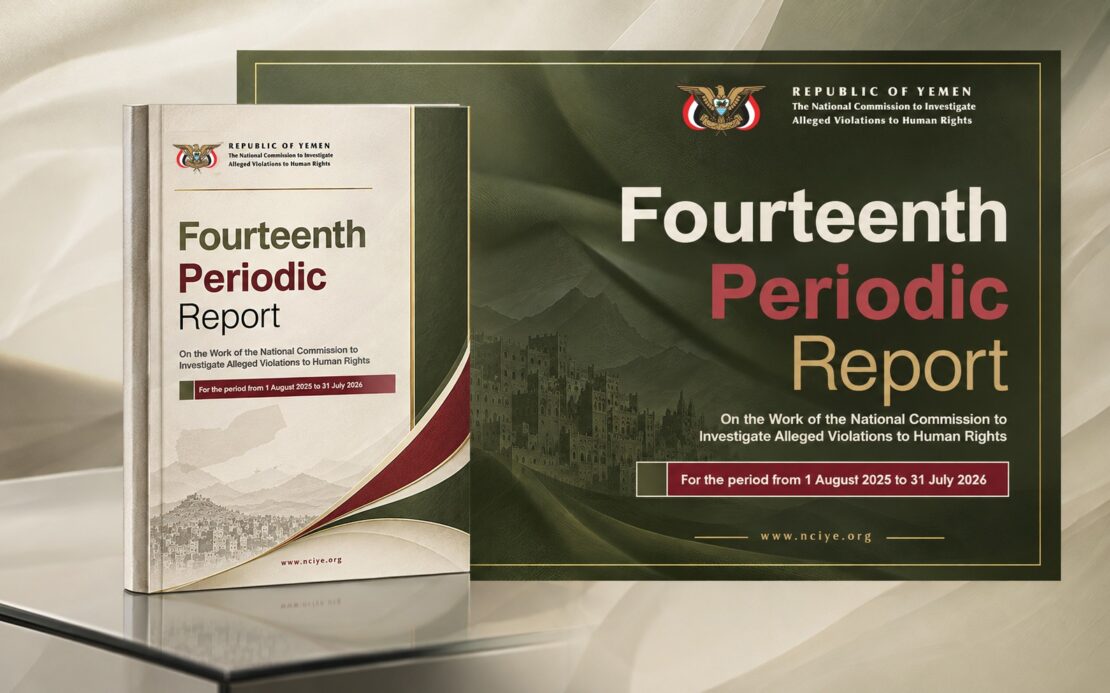
The National Commission to Investigate Alleged Violations of Human Rights launched its Fourteenth Periodic Report today, Thursday. The report covers the period from 1 August 2025 to 31 July 2026.
The report documented 2,062 incidents of human rights violations affecting 2,932 male and female victims across various Yemeni governorates. These incidents encompassed more than 36 categories of human rights violations. This brings the total number of violations monitored and documented by the Commission since it began its work in January 2016 through the issuance of this report to 35,015 incidents involving 70,470 victims.
The report explained that the period under review was marked by continued political stalemate, a fragile military de-escalation, and intermittent clashes, sniper attacks, and shelling in several governorates, alongside developments affecting maritime security in the Red Sea, the Gulf of Aden, and the Bab al-Mandab Strait. This coincided with a worsening economic crisis, deteriorating essential services, and growing humanitarian needs, all of which directly affected the population’s enjoyment of their fundamental rights and freedoms.
The Commission’s teams continued their monitoring and investigative work across the governorates through a network of 44 male and female field monitors. During the reporting period, the Commission heard testimony from more than 8,818 witnesses, complainants, and victims and examined approximately 5,280 documents. It also reviewed and analysed hundreds of photographs and video recordings and preserved them in the Commission’s database.
The Commission conducted a wide range of field visits to the governorates of Hadramout, Socotra, Shabwah, Marib, Aden, Taiz, Lahj, and Hodeidah. These visits covered official and unofficial prisons and detention facilities, sites where violations had occurred, and a number of public and service facilities. The visits focused on verifying reported incidents, examining evidence at the sites, interviewing detainees, victims, and witnesses, and assessing the extent to which detention facilities complied with legal safeguards and humanitarian standards.
The Commission held public and collective hearing sessions for victims and relatives of victims in the Hadramout Coast, Seiyun, Aden, Socotra, Shabwah, Al-Turbah, and Al-Mokha. The hearings addressed incidents of arbitrary detention, enforced disappearance, torture, forced displacement, attacks on property, and violations of freedom of opinion and expression. The testimonies and documents presented during these sessions contributed to completing investigation files and establishing the rights of victims.
As part of its efforts to advance accountability, the Commission held meetings with representatives of judicial, executive, security, and military authorities in several governorates. The meetings addressed the cases being followed by the Commission, its observations regarding conditions in prisons and detention facilities, and guarantees of a fair trial. The Commission also continued its cooperation with civil society organisations and relevant regional and international bodies and participated in meetings dedicated to presenting the findings of its work, exchanging information, and building capacity in support of national monitoring and investigative efforts.
As part of its engagement with the parties to the conflict and other relevant entities, the Commission sent 15 official memoranda to 11 government, security, and military bodies, seeking information about incidents under investigation and following up on internal accountability measures. The report noted that the Houthi group continued to neither respond to the Commission’s correspondence nor appoint a liaison officer to coordinate with it. Nevertheless, the Commission’s field monitors continued their documentation and investigative work in areas under the group’s control.
Regarding investigations into violations of international humanitarian law, the report stated that the Commission had completed the monitoring and investigation of 501 incidents involving civilian deaths and injuries. These incidents resulted in the deaths of 193 civilians, including 30 children and 15 women, and injuries to 388 others, including 73 children and 36 women. The report attributed 446 incidents to the Houthi group, 31 incidents to government forces, and 24 incidents to other entities.
The report documented 57 alleged cases of the recruitment of children under the age of 18. The Houthi group was found responsible for 56 of these cases, while one case was attributed to the Government and affiliated entities.
Regarding landmines, the Commission completed the monitoring, documentation, and investigation of 112 landmine explosion incidents that resulted in 120 victims. Sixty-four civilians, including eight children, were killed, while 56 others, including five women and seven children, were injured.
The Commission investigated nine incidents involving attacks on religious, cultural, and historical sites, as well as one incident involving an attack on medical facilities and personnel. The report attributed responsibility for these incidents to the Houthi group. It also documented 55 incidents of collective and individual forced displacement affecting 139 victims. The Houthi group was found responsible for 53 of these incidents, while one incident was attributed jointly to parties to the conflict and another to other entities.
Regarding violations of international human rights law, the Commission completed its investigation into 45 incidents of extrajudicial killing. The Houthi group was found responsible for 33 of these incidents, government forces for two incidents, and other entities for 10 incidents.
The report recorded 534 incidents of arbitrary detention and enforced disappearance across various governorates, of which 371 were attributed to the Houthi group, 124 to government forces, and 39 to other entities. The Commission also investigated 24 incidents of torture and ill-treatment. The Houthi group was found responsible for 12 of these incidents, security agencies affiliated with the Government for nine incidents, and forces affiliated with Aidarous al-Zubaidi for three incidents.
Regarding property-related violations, the report documented 459 incidents involving the destruction of or damage to private property, affecting 707 victims. It also documented six incidents involving the demolition of homes, for which the investigations established the responsibility of the Houthi group. In addition, the Commission recorded 145 incidents of terrorising civilians and spreading fear, affecting 187 victims, as well as 78 incidents involving the planting of vehicle mines and improvised explosive devices, resulting in 83 victims.
The report dedicated a section to violations affecting women, addressing various forms of physical and psychological violence, arbitrary detention, enforced disappearance, displacement, and restrictions on freedom of movement and participation in public life. It highlighted the compounded effects of these violations on women and their families and presented examples of incidents that the Commission had completed investigating and attributed to various parties.
The report also addressed the findings of the Commission’s investigation into the attack on Ras Isa Port in Hodeidah Governorate on 17 April 2025. According to the Commission’s documentation, the attack resulted in the deaths of approximately 84 civilians and injuries to 150 others, in addition to damage to the oil facility and vehicles located at the site.
The report also presented the findings of the Commission’s investigations into attacks on three commercial vessels in the Red Sea: the MV Tutor, Magic Seas, and Eternity C. These attacks resulted in deaths, the detention of crew members, the sinking of vessels, and the leakage of fuel, oils, and cargo materials, threatening maritime safety, the marine environment, and fishers’ livelihoods. Based on statements, reports, photographs, video recordings, and acknowledgements by the perpetrating party, the investigations concluded that the Houthi group was responsible for these incidents.
The report noted the persistence of several challenges affecting the Commission’s monitoring and investigative work. These primarily included security restrictions and pressures that hindered access to victims, witnesses, and sites of violations, particularly in areas under the control of the Houthi group. Other challenges included the disruption of avenues for remedy and reparation, weak enforcement of investigative outcomes, and the resulting decline in confidence among some victims and witnesses and their reluctance to report violations. The Commission also faced methodological challenges related to documenting violations of economic and social rights and determining responsibility for them.
The Commission concluded its report with a series of recommendations, calling on all parties to the conflict to comply with international humanitarian law and international human rights law, protect civilians and civilian objects, immediately cease violations, release arbitrarily detained persons and victims of enforced disappearance, disclose the fate of missing persons, end the recruitment of children, and remove landmines and explosive remnants of war while mitigating their impact on civilians.
The Commission called on the Houthi group to lift restrictions imposed on public freedoms and media and civil society activities; release journalists, humanitarian workers, and human rights defenders; and end arbitrary detention, enforced disappearance, torture, and ill-treatment. It called on the Government of Yemen to strengthen the rule of law, activate justice institutions, expedite investigations and prosecutions in cases involving human rights violations, support judicial independence, improve economic conditions and essential services, continue cooperating with the Commission, and facilitate its field activities.
The Commission recommended that judicial authorities and law enforcement agencies prioritise the investigation of serious violations, guarantee detainees’ rights and the right to a fair trial, strengthen oversight of detention facilities, and protect victims, witnesses, and complainants. It urged the international community and international and regional organisations to support peace efforts, economic recovery, mine clearance, and reparations and to provide technical, institutional, and capacity-building support to national institutions concerned with protecting human rights, foremost among them the National Commission to Investigate Alleged Violations of Human Rights.
In concluding its report, the Commission affirmed that, as an independent national mechanism, it would continue to carry out its mandate impartially and professionally and would persist in its efforts to reach victims, establish their rights, and preserve evidence in support of accountability, redress, and the fight against impunity.
The full version of the Fourteenth Periodic Report is available on the official website of the National Commission to Investigate Alleged Violations of Human Rights.
To check the Fourteenth Periodic Report Summary of the National Commission to Investigate Alleged Violations of Human Rights (in English), please visit the following link:
https://nciye.org/reports/FourteenthReport/FourteenthReport-en.pdf


